
Agencies aren’t struggling to create campaigns. They’re struggling to execute them efficiently as audiences, channels, and reporting demands become harder to coordinate.
As a result, many agencies are finding that success depends not only on strategy and creative execution but also on their ability to simplify complexity and execute efficiently.
Today’s agencies are being asked to deliver stronger performance while managing:
- Smaller teams
- Tighter budgets
- Growing client expectations
- More channels
- More reporting requirements
At the same time, consumers are becoming harder to reach as attention spreads across platforms, devices and content sources.

What used to be a campaign is now a system including multiple channels, vendors and reporting layers that are harder to manage and harder to optimize. As a result, many agencies are finding that client success depends not only on strategy and creative execution but also on the partnerships that help support campaign delivery.
Why fragmented audiences create fragmented campaigns
Consumers no longer move through a linear path from awareness to purchase. Before making a decision, they may interact with a brand dozens of times across multiple platforms, devices and content sources, often without following any predictable pattern.
A potential customer may encounter a brand through:
- A search engine
- A social media platform
- A local news website
- A video ad
- An email campaign
- Multiple devices throughout the day
For agencies, every additional touchpoint creates another layer of complexity.
Common challenges include:
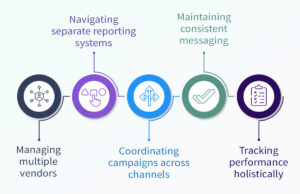
What begins as an effort to expand reach can quickly become difficult to manage and optimize.
Many agencies are looking for ways to simplify campaign execution without sacrificing performance. Working with media partners that provide access to multiple channels and audience opportunities through a single relationship can help reduce operational complexity while supporting campaign goals.
The more fragmented the audience becomes, the more valuable simplicity becomes.
How local relevance can be the difference between awareness and action
Reach is important, but reach alone does not guarantee results.
Consumers are exposed to thousands of marketing messages every day. The campaigns that break through are often the ones that feel relevant and familiar.

Local relevance can influence:
- Brand awareness
- Consumer trust
- Engagement
- Purchase consideration
- Long-term brand recall
For many businesses, national visibility is only part of the equation. Local credibility often plays an important role in whether consumers take the next step.
While advertising channels and consumer behavior continue to evolve, the importance of local relevance has not disappeared. In fact, many businesses are finding that trusted local environments remain a valuable way to build awareness and credibility. Learn more about what’s changed, what still works and why local advertising still matters.
Trust is difficult to build through a single impression. Repeated exposure in familiar local environments can help reinforce awareness and credibility over time.
Agencies that combine broader targeting strategies with trusted local environments can help clients create stronger audience connections. When consumers repeatedly encounter a brand in places they already trust, awareness can turn into action more effectively.
This is one reason local media continues to play an important role within broader marketing strategies. Reaching more people doesn’t matter if you’re not reaching the right community.
How agency teams are stretched thinner than ever
Agency teams are being asked to do more than ever before, often without additional time, resources or support.

Many teams are simultaneously managing:
- Campaign strategy
- Client communication
- Vendor relationships
- Performance reporting
- Optimization and troubleshooting
As workloads increase, operational demands can consume time that would otherwise be spent on strategic planning and client service.
According to Resource Guru’s 2025 Agency Report, 95% of agency workers report working overtime to meet client deadlines, and 88% report working on weekends.
The right media partner can help reduce that burden. Today, the difference between average and high-performing campaigns isn’t just strategy. It’s how efficiently campaigns are executed, optimized, and coordinated across channels.
By providing audience insights, hands-on campaign support, optimization recommendations, and streamlined reporting, strong media partners function as an extension of the agency team rather than another vendor to manage. As the number of vendors grows, so does the complexity of measuring performance. The right partner helps simplify execution and deliver a clearer view of what’s driving results.
When agencies spend less time coordinating logistics, they gain more time to focus on strategy, client relationships and driving results.
Why performance improves when channels work together
Consumers don’t experience brands one channel at a time. A Harvard Business Review study of 46,000 shoppers found that 73% of consumers use multiple channels during their buying journey. A potential customer may see a display ad during their morning news browse, encounter a social media post later that afternoon and conduct a search before making a purchase decision. To the consumer, these interactions are part of a single experience, even if they occur across multiple channels.
Throughout the customer journey, consumers may encounter a brand through:
- Display advertising
- Social media
- Email marketing
- Video content
- Search engines
- Local news and media sites
Each interaction contributes to how they perceive that brand.
This research reinforces a simple reality: consumers don’t separate their experiences by channel.
Brands that deliver consistent messaging across touchpoints are better positioned to build trust, remain top of mind and influence purchase decisions throughout the customer journey.
When campaigns operate independently, opportunities can be lost. Messaging may become inconsistent. Reporting may become disconnected. Audience experiences may feel fragmented.
This is where the right media partner can make a meaningful difference. Rather than forcing agencies to coordinate multiple disconnected vendors, strong media partners help create alignment across channels, audiences and campaign objectives.

The most effective media partnerships support agencies by helping them:
- Reinforce messaging across channels
- Increase audience familiarity and frequency
- Create more consistent customer experiences
- Simplify measurement and reporting
- Identify optimization opportunities
- Support stronger campaign performance
By bringing multiple opportunities together under a coordinated strategy, media partners can help agencies reduce complexity while improving campaign effectiveness.
As consumer behavior continues to evolve, integrated approaches and collaborative partnerships will become increasingly important for agencies looking to maximize results.
Strong campaigns are not built channel by channel. They are built around the customer journey.
The challenges facing agencies are not getting simpler.
Audiences will continue to fragment. Client expectations will continue to rise. Agencies will continue to face pressure to do more with limited time and resources.
The agencies that consistently deliver strong results are often not the ones using the most vendors or the most channels. They are the ones creating efficient systems that support stronger execution, better performance and better client outcomes.
The right media partner can help support that process.
Agencies don’t need more vendors. They need fewer, better-aligned partners that simplify execution and improve results. That’s why Forum Communications Advertising serves as a collaborative partner that supports both agency teams and the clients they represent.
Sources: Emma Sopadjieva, Utpal M. Dholakia and Beth Benjamin, “A Study of 46,000 Shoppers Shows That Omnichannel Retailing Works,” Harvard Business Review, January 2017.